If you were to come visit me, you would notice a small orchard at the front of our property and would have to pass under these large trees planted on either side of the driveway.
At other times of the year you might wonder what kind of trees they are. They must be almost 70 feet high with thick sturdy trunks.
 However at this time of the year, it's not hard to figure that out. As you walk up the driveway you will feel a crunch under your feet. Looking down this is what you'll find.
  Walnuts.
If you look up into the tree you will see green globes hanging from the tree
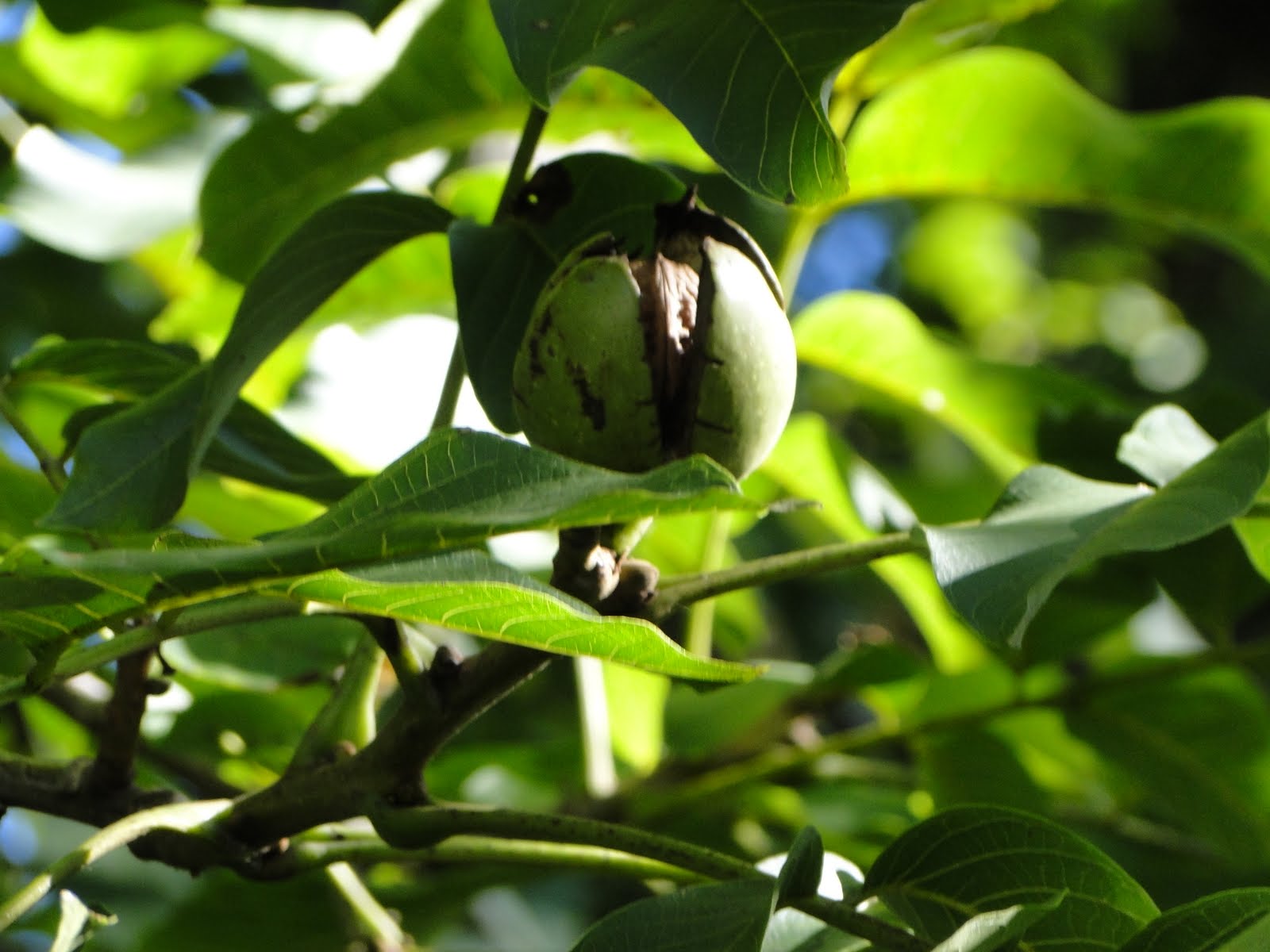
I found one that was still nestled in its cracked case.

Picking them up, it's better to wear gloves as the fibers inside the green case will stain your fingers a dark brown. (our great grandmothers used walnut skins to make brown dye) Each year we would gather the walnuts, dry them, crack them, toast them and eat them but in recent years I've developed an allergy to them so the crows and squirrels are now the grateful recipients of nature's largesse.
If you look to the right, you'll see the orchard floor covered in very prickly pods.


Picking up nuts in our orchard can be hazardous. These prickly pods can incur sore fingers and because they litter most of the orchard you'll want to wear thick soled shoes.
 Looking up into the tree above you will see the green pods and brown tassles of
an English Chestnut tree.
In spring this tree is gorgeous with light green tassels highlighting it's bright foliage.

This is what the chestnuts look like after they've fallen to the ground. This years crop is not as good as last year so the chestnuts are smaller, but each pod contains 3 chestnuts with the centre one being larger than its bedfellows. These are the type of chestnuts that the song says are "roasting on an open fire" and that go into chestnut stuffing. I haven't used these chestnuts although I keep intending to.
The nuts I use most often are the ones that grow on these trees on the edge of the orchard.
 Again, if you look up you may still find a few nuts on the tree, although most have fallen by now.
These are hazelnuts and they grow in these clusters which look like babies in blankets.

They are prolific trees, producing far more nuts than we can eat. And, yes, you might want to be careful as you pick these up as well. You may pick a wild mushroom by mistake as they thrive under the thick foliage and in the slanting fall light can easily be mistaken for nuts..

Or, far worse, in my estimation, would be grabbing or even touching one of these BC sized slugs. (Ugh!)

What do I do with all these nuts? Well, I share them with friends and relatives, I use them in baking of course, and for fall decorating.

(Those horse chestnuts came from a tree up our road which I didn't get a picture of.)
And last but not least, I use them in a favourite pasta dish at our house:
 Chicken Linguini with Hazelnuts.
- Linguini noodles
- 1 tablespoon olive oil
- 2 or 3 boneless chicken breasts cut into slices
- 2 cloves garlic, minced
Alfredo sauce (or you can use a prepared Alfredo sauce)
- 1/4 cup butter
- 1 cup heavy cream
- 1/2 cup grated parmesan cheese
- 1/2 cup coarsely chopped hazelnuts
- 1 tablespoon chopped fresh parsley
- Boil a pot of water and add salt and enough linguini noodles for your family.
- While the noodles are cooking, heat a tablespoon or two of olive oil in a fry pan.
- Add minced garlic and the chicken pieces.
- Saute until nicely browned and well cooked. Set aside.
- In a small pot, melt butter.
- Add heavy cream and heat without boiling, stirring occasionally until slightly thickened.
- Add grated parmesan cheese and stir until melted.
- Drain pasta, toss with Alfredo sauce and place on a large platter.
- Top with chicken pieces, chopped hazelnuts and freshly chopped parsley.
Serves 4-6


